
Criminal Court Cases in Indian River County
The Nineteenth Judicial Circuit serves Indian River, Martin, Okeechobee, and St. Lucie Counties. In Indian River County, Circuit Court hears capital, life, first-degree, second-degree, and third-degree felonies. County Court hears first- and second-degree misdemeanors, criminal traffic, and county or municipal ordinance prosecutions. Florida abolished separate city criminal courts, so a Vero Beach, Sebastian, or Fellsmere police case still reaches the Indian River County Clerk when a charge is filed.
Ryan Butler, Clerk of the Circuit Court and Comptroller, is custodian of the judicial file. The main public counter is at 2000 16th Avenue, Vero Beach, FL 32960. Call 772-226-3100 or email clerk@indianriverclerk.com for routing. Clerk staff can explain access and copy channels, but cannot give legal advice or move a hearing date.
Indian River Felony and Misdemeanor Courts
The court level follows the filed offense, not merely the label seen during booking. The State Attorney may file an information, revise the arrest charge, or decline prosecution. Once filed, each court charge receives docket events and its own result. This is why the Indian River County case file is the better source for a final outcome.
| Case level | Indian River court | Typical file |
|---|---|---|
| Felony | Circuit Court | Information or indictment, motions, plea or trial, judgment, sentence |
| Misdemeanor | County Court | Filed complaint, hearings, disposition, sentence |
| Criminal traffic | County Court | Citation or complaint, plea, judgment, sanctions |
| City ordinance crime | County Court | City agency report followed by county judicial file |
The nearby State Attorney and Public Defender offices are also in the Vero Beach courthouse, but their office files are not interchangeable with the clerk's official docket.
Indian River County Case Record Searches
The free Online Case View is the primary public portal. It confirms access to case information, dates, charges, sentences, complaints, parties, and available images. Exact vendor control labels can change, so the clerk's stated inventory is safer than promising fields that may not appear in every search mode.
- Open Online Case View and accept the public-access terms.
- Search with the party name or known case number and use spelling variants when needed.
- Compare court, filing date, case type, and parties before selecting a match.
- Open the docket and read events by charge, noting later changes and disposition entries.
- Contact the clerk for a certified disposition, older image, or public document not available online.
| Search detail | Type | Availability | Use |
|---|---|---|---|
| Party name | Text | Confirmed in case information | Find possible files, then verify other details |
| Case number | Identifier | Core case identifier | Reach a known judicial file |
| Charges | Case detail | Confirmed | Read accusations as filed in court |
| Court dates | Schedule | Confirmed | Track scheduled events that may change |
| Sentences and images | Disposition/document | Confirmed where public | Read outcome and source documents |
Indian River Files Before Late 2008
Public document images generally begin in late 2008. Some older cases have images, but the absence of a scan does not mean there is no case or public paper file. Give the clerk a case number, defendant name, approximate year, and the exact document sought. That detail reduces research time and helps staff distinguish a docket printout from a certified judgment or disposition.
The courthouse counter is the main route for older material and certification questions. A northern-county alternative is the Sebastian clerk office at 1921 U.S. Highway 1, Sebastian, FL 32958. It is open Monday, Wednesday, and Friday from 8:30 a.m. to 5 p.m., not five days a week. Call 772-226-1147 before relying on that office for a specific criminal record service.
Note: Free online viewing does not make certified copies free; Clerk service and certification charges are governed by Florida law and the current fee page.
What a Criminal Case File Contains
An Indian River County criminal case file organizes the prosecution rather than the arrest. The charging instrument shows what the State Attorney took to court. The docket logs hearings, filings, and orders. A final result must be read charge by charge because one count may be dismissed while another ends in withheld adjudication or conviction.
| Case Number & Court | The unique judicial file and whether it belongs in Circuit or County Court. |
|---|---|
| Charging Document | The information, indictment, complaint, or citation stating the filed accusation. |
| Docket Entries | A dated event log of filings, hearings, motions, orders, pleas, and notices. |
| Hearing Dates | Scheduled first appearance, arraignment, status, pretrial, plea, trial, or VOP events. |
| Disposition & Judgment | The result for each count, including dismissal, acquittal, withheld adjudication, or conviction. |
| Sentence & Conditions | Jail or prison, probation, costs, fines, treatment, and other court-ordered terms. |
The file may not expose every prosecutor record, victim detail, financial entry, or document image. Protected data is removed or restricted under Florida access rules.
Indian River First Appearance Schedule
The Clerk states that people arrested during the preceding 24 hours appear for first appearance at 8:30 a.m. every day, including weekends and holidays. The judge reviews custody and release issues. The hearing is not the final trial and does not prove that the arrest charge will be filed without change.
After review, the State Attorney may file an information, alter the arrest charge, or decline to prosecute. Arraignment then advises the accused of the filed charge and takes a plea. A not-guilty plea may lead to status conferences, discovery, motions, pretrial, a negotiated plea, or jury trial. Probation allegations use a violation-of-probation path.
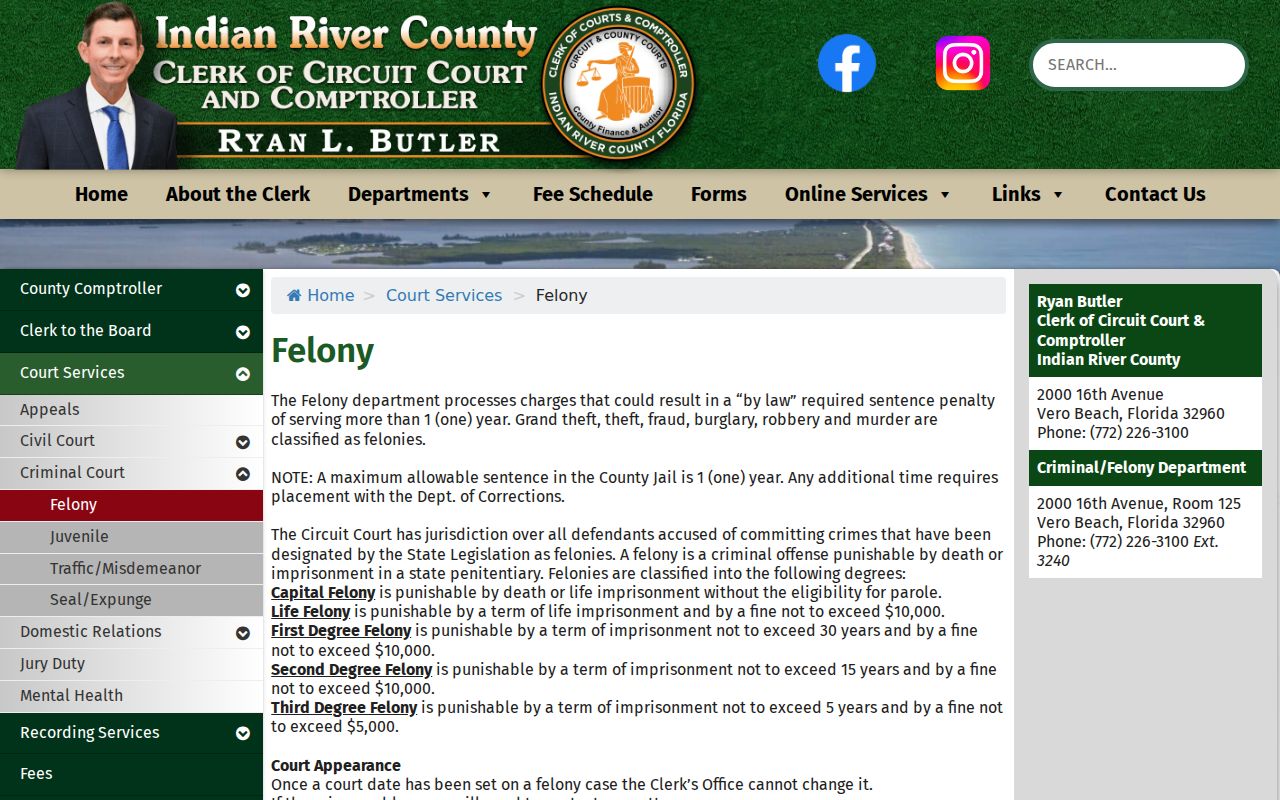
The Clerk's felony service page supplies the official local process.
That sequence explains why a very recent booking may appear before any matching Indian River County court case is visible.
Read Indian River Case Outcomes
Short docket terms can change the meaning of a record. Read the result next to the correct charge and date. Do not turn a prosecutor's dismissal into an acquittal or treat withheld adjudication as if the court entered a formal conviction.
- Nolle prosequi
- The prosecutor ends a charge.
- Dismissal
- The court terminates the charge without a conviction on that count.
- Adjudication withheld
- The court does not formally adjudicate guilt after a plea or finding, subject to the order.
- Acquittal
- A not-guilty result after trial.
- Capias
- A court command for arrest, often visible after a failure to appear.
- Disposition
- The outcome of a specific filed charge.
If an FDLE history lacks the final Indian River County disposition, compare it with the clerk file and use FDLE's Personal Review and challenge route for your own state record.
Criminal Case Stages in Indian River County
A court file develops over time. The arresting agency begins with an allegation, but the State Attorney controls the filed accusation and the clerk preserves each later event. Dates can change, and clerk staff cannot move them on request.
Case flow: Charges Filed › Arraignment › Pretrial › Plea or Trial › Disposition › Sentencing
A failure to appear can produce a capias, bond forfeiture, and later no-bond detention depending on the judicial order. Search the underlying docket and call the court or counsel before taking action on an apparent warrant. The jail page alone cannot show whether a warrant remains active.
Indian River Charging and Clerk Roles
The State Attorney files or declines charges. The clerk preserves the case. Those roles create distinct records. Prosecutor correspondence, discovery administration, and office records use the Nineteenth Circuit State Attorney request channel. Court-file copies belong with the Indian River County Clerk. A sheriff records request cannot replace either source.
The official State Attorney page identifies the prosecution office serving Indian River County.
The Indian River branch is at 2000 16th Avenue, Suite 329, Vero Beach, with phone 772-226-3300. The Public Defender is in Suite 235 at 772-226-3340.
Indian River Treatment Court Dockets
Circuit 19 operates named Adult Drug, Veterans Treatment, and Mental Health Courts. Adult Drug Court is a judicially supervised treatment program with a February 2025 handbook and Judge Robyn Stone listed as presiding judge. Veterans Treatment Court, led by Judge Nicole Menz, serves qualifying people whose military-related mental-health or substance-use needs contributed to a pending case. Mental Health Court accepts qualifying pending felony or misdemeanor cases involving severe mental illness or intellectual disability.
Participation can create added docket entries, treatment conditions, reviews, and supervision events. Never infer enrollment from a charge alone. Confirm it in the Indian River County case file. These programs do not erase the court record merely because treatment is part of the resolution.
Access Rules for Case Records
Florida judicial access follows Rule 2.420, while clerk fees are governed in part by section 28.24. Juvenile, adoption, Baker Act, Marchman Act, tuberculosis, sexting-infraction, specified guardianship and mental-health matters are excluded from ordinary public search. Unserved injunction petitions remain withheld until service. Some family, probate, guardianship, and mental-health images require registered or attorney-of-record access.
A blank search can result from spelling, timing, older image coverage, confidentiality, sealing, expunction, or a case that was never filed. Call 772-226-3100 or visit the clerk counter instead of guessing. The public-record liaison, Brandon Young at 772-226-3173, routes administrative public-record matters, but judicial case copies still belong with court-record services.
Federal charges do not appear in Online Case View. Indian River County lies in the Fort Pierce Division of the Southern District of Florida, where PACER provides the federal docket. A county case search and FDLE criminal history also answer different questions: one is case-centered and local, while the other is person-centered and statewide.