
Indian River County Sex Offender Checks
The Florida Sexual Offender/Predator Registry is the primary public source for Indian River County. FDLE manages the statewide records. It lets readers search by a name or place, filter the results, open a detailed flyer, use a map, and track a person. The search is free and does not require a login.
IRCSO's Offender Tracking Unit is the local registration office. It receives required reports, reviews proposed addresses under the local process, and accepts reports of suspected noncompliance. The sheriff does not replace the state registry with a separate public list. For a person who may have moved across state lines, the federal NSOPW search supplies a national layer.
Indian River Registry Search Without a Name
Exact spelling is not needed for a useful Indian River County registry lookup. The ordinary FDLE form requires at least one name or location field. Leave the name fields blank and choose Indian River from the County menu to return the county pool. Then narrow it by offender type, registration status, city, ZIP, aliases, or thumbnail display. Partial names are also accepted.
The official FDLE registry form shows the live county, status, and display controls.
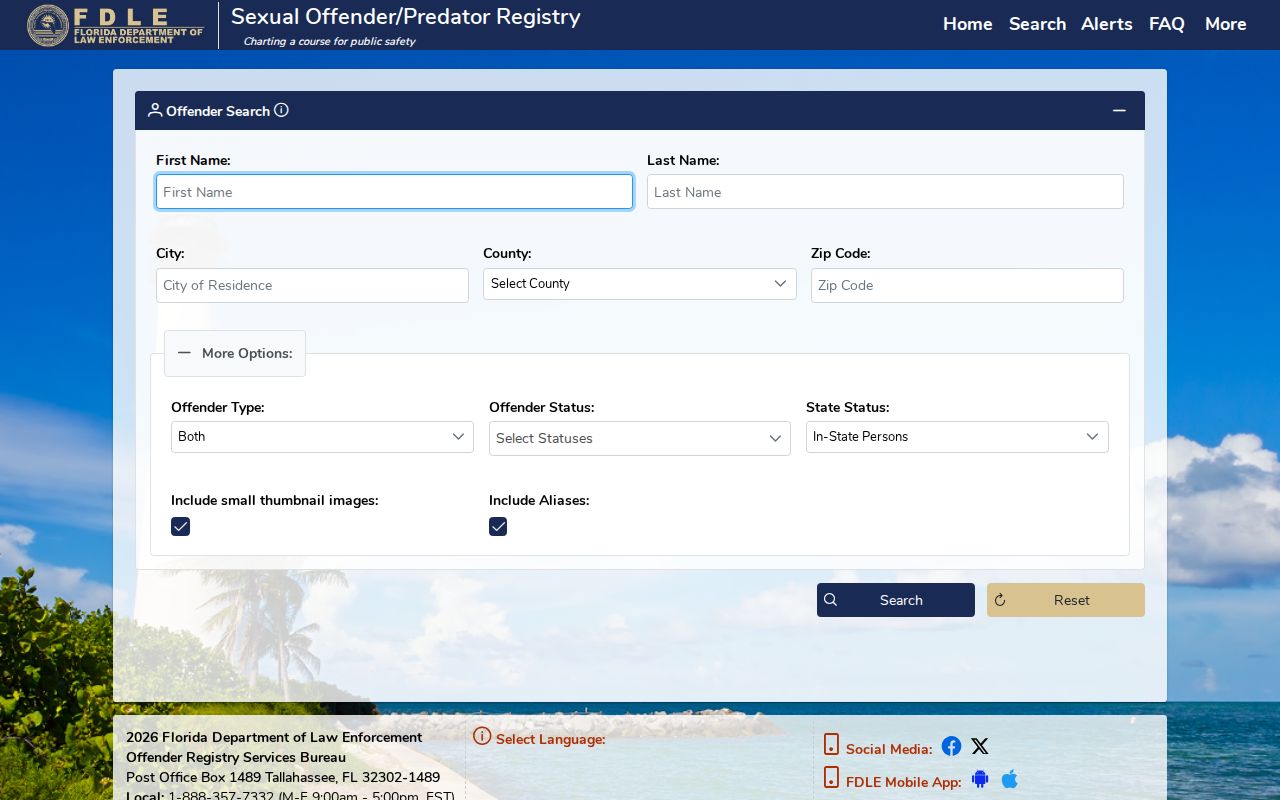
List and map views support different tasks. A list is better for comparing names and statuses. A map provides place context, but the full flyer remains the source for address type and received date.
Florida Sexual Offender/Predator Registry Searches
Use the state tool in a set order so that broad filters do not hide a relevant Indian River County record. Matching only a name can join people who are not the same. Matching only a map point can miss transient or changed-address details. Open the detailed record before reaching a conclusion.
- Open the FDLE offender search. Enter a partial or full name, or leave names blank and select Indian River County.
- Apply offender or predator and status filters only when they serve the question. Choose whether to show thumbnails or aliases.
- Review the list or map, then compare aliases, birth data, physical details, and status to distinguish similar names.
- Open the flyer and read each address type, source, received date, qualifying offense, and current registration status.
| Field | Type | Required | Options or format |
|---|---|---|---|
| First and last name | Text | One name or location field | Partial names accepted |
| City | Text | Optional | May serve as the required place field |
| County | Dropdown | Optional | Select Indian River for a county-wide list |
| ZIP | Text | Optional | May serve as the required place field |
| Offender type | Dropdown | Optional | Both, offender, or predator |
| Status | Multi-select | Optional | Includes absconded, confined, released-registration, and several supervision states |
| Display | Controls | Optional | Thumbnail, aliases, and list or map |
Indian River Offender Registry Radius Maps
The FDLE neighborhood mode centers on an address, city, and ZIP. Radius choices run from one-quarter mile through one-half, one, two, three, four, and five miles. Map symbols distinguish offender, predator, transient offender, and transient predator. Zoom, pan, recenter, and imagery controls help explore the area.
The FDLE neighborhood search shows the actual radius and map interface for Indian River County registry checks.
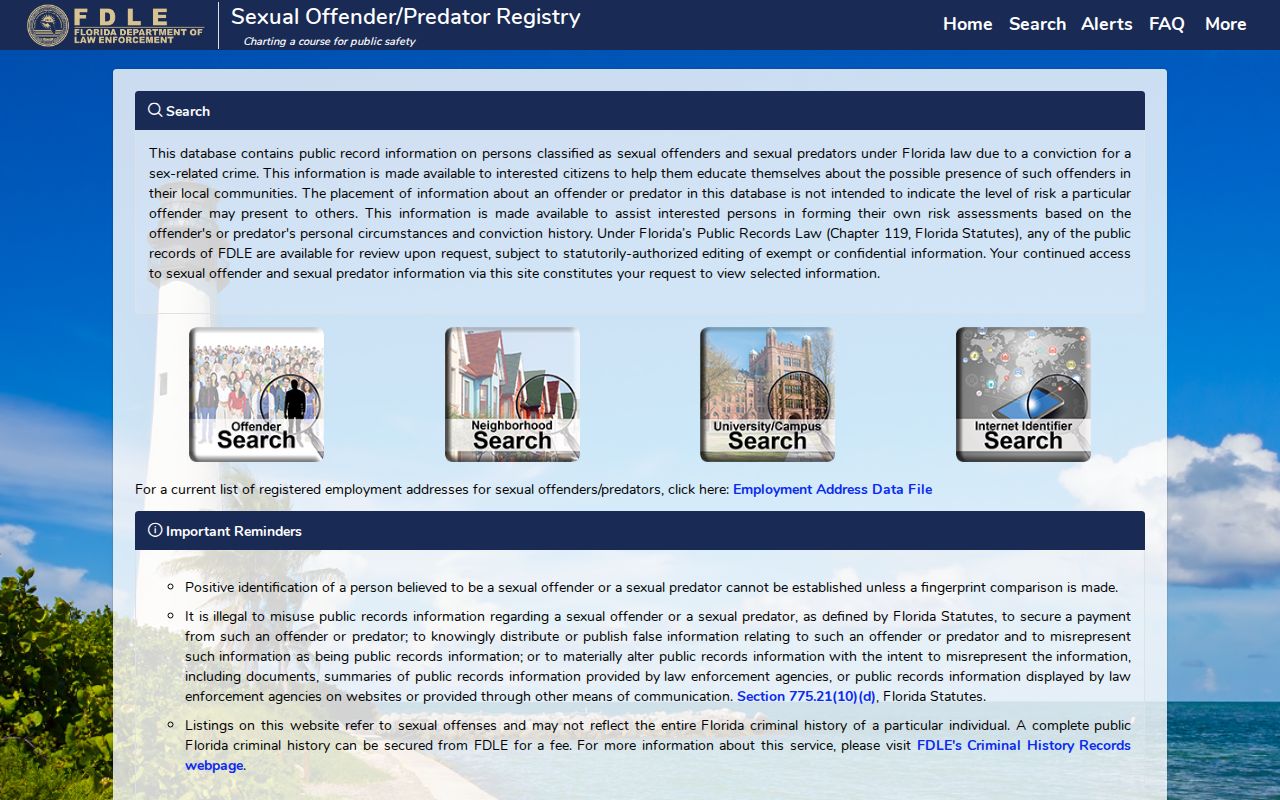
A pin is not a property survey or proof that a person is standing at that spot. Read whether the address is permanent, temporary, transient, or another type. Check the source and date received. Those fields give the point meaning and can explain why one profile lists more than one address.
Registry Profiles: What They Show
An FDLE flyer combines recognition details, registration status, addresses, and the legal basis for registration. It is not a complete Indian River County criminal history. The listed qualifying offenses explain the registration basis, not every criminal event. Victim facts are deliberately limited, and FDLE states that it does not independently verify every fact supplied by registrants and contributing agencies.
| Identity | Name, aliases, sex, race, birth data, height, weight, hair, eyes, and scars, marks, or tattoos. |
|---|---|
| Photograph | A recognition aid; fingerprints remain necessary for positive identification. |
| Designation and status | Sexual offender or judicially designated sexual predator, plus the current registry or supervision status. |
| Addresses | Permanent, temporary, transient, and other entries with address type, source, and received date. |
| Qualifying offenses | Description or statute, adjudication date, case, jurisdiction, and adjudication data. |
| Other details | Vehicle or vessel descriptions, tags, and institutional or campus items when applicable. |
The official FDLE flyer interface demonstrates the registry profile structure.
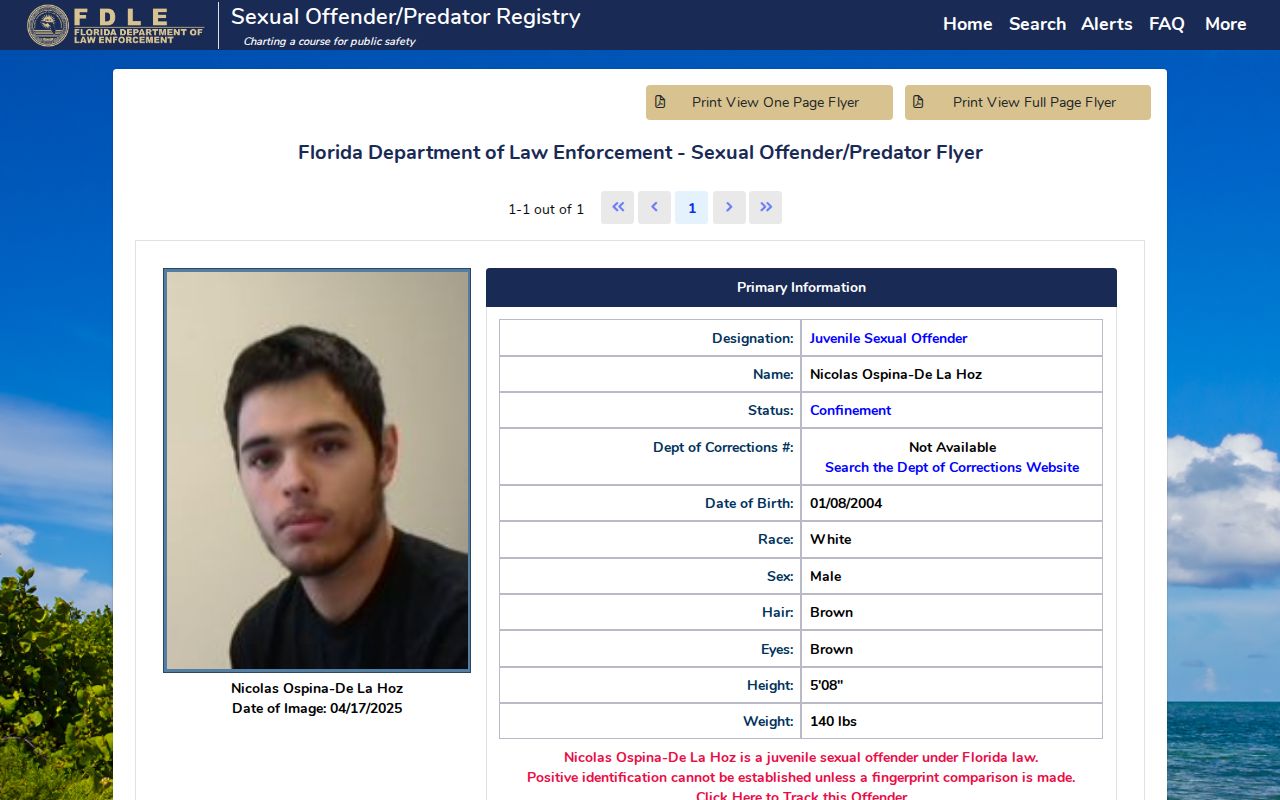
Compare the photograph and identifiers, but do not claim a positive identity from the public page alone. Vehicle information also does not mean that a registrant uses only the listed property at all times.
Indian River Offender Registration at Building K
Local reporting takes place by appointment with the IRCSO Offender Tracking Unit at Building K/Visitation, 4055 41st Avenue, Vero Beach. Appointments run Tuesday through Thursday, excluding holidays, with the last appointment at 4:30 p.m. Contacts are 772-978-6351, alternate 772-584-0840, and sexoffender@ircsheriff.org.
The official tracking page shows the Indian River County registration office, schedule, and administrative fees.
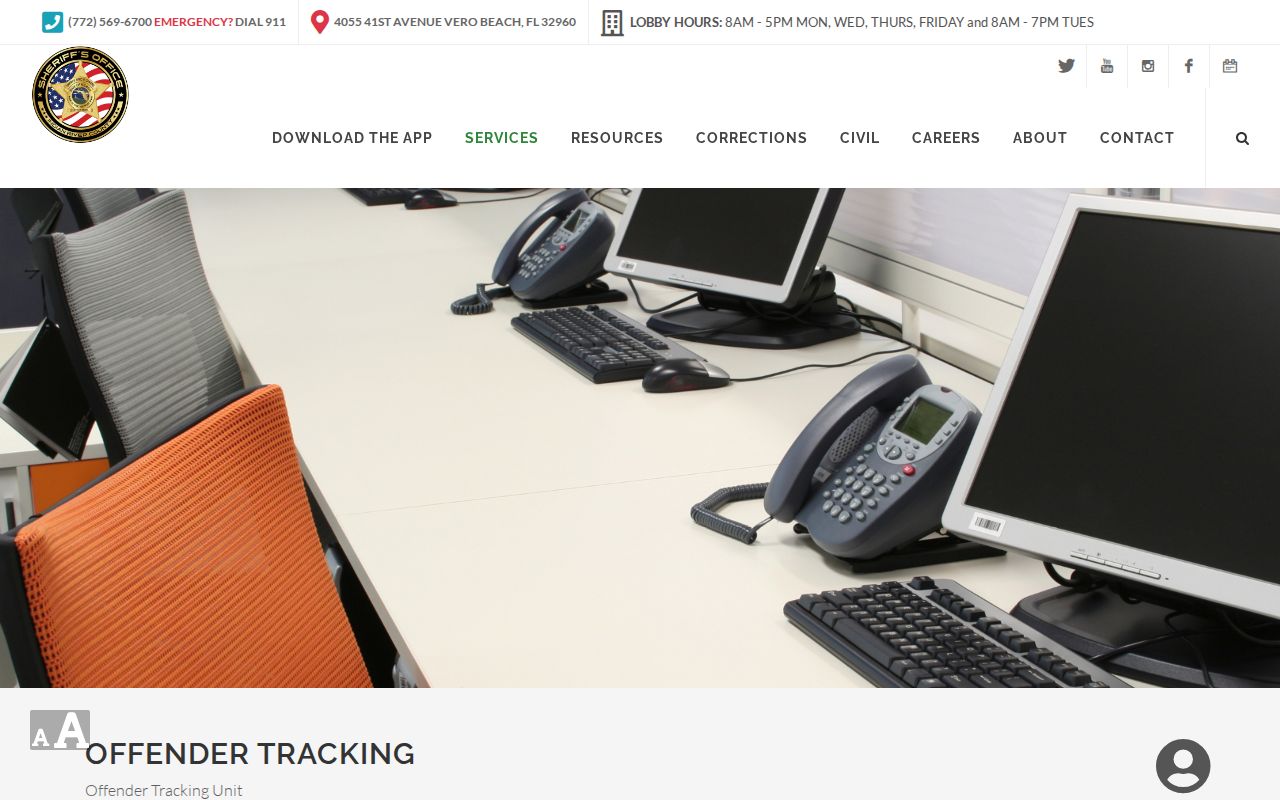
The local fee is $50 for initial registration, $25 for quarterly or biannual reregistration, $10 for an in-person information update, and no fee for transient registration. These charges apply to the Sheriff's administrative process. Searching the public FDLE registry remains free.
Registration Levels and Duties in Florida
Florida does not publish a three-tier risk score. It uses sexual offender and sexual predator designations. Predator status requires statutory criteria and a written judicial designation; FDLE cannot assign that label on its own. The public label also is not an individualized finding of current dangerousness.
| Florida category | General duration | Indian River reporting pattern |
|---|---|---|
| Sexual offender | Generally lifetime; a narrow court petition may exist after at least 25 qualifying years under §943.0435(11) | Generally twice each year, unless a specified category requires more |
| Sexual predator or specified category | Generally lifetime; no ordinary predator removal petition identified absent pardon or post-conviction relief | Four times each year for predators and specified offender or juvenile categories |
| Transient registrant | Follows the applicable underlying registration duty | Additional reporting every 30 days |
Covered people generally report an Indian River County residence within 48 hours, obtain proposed-address approval before moving, and report departure in person. Juvenile duties depend on qualifying statutory conditions. A court, not the search portal, decides whether the narrow removal provisions apply.
Indian River Sex Offender Residence Rule
IRCSO ties local address review to Indian River County Ordinance 2023-005 and describes a 2,500-foot restriction for covered people near schools, care facilities, parks, or playgrounds. The rule should not be turned into a blanket answer about any address. Applicability can depend on the person's category, conviction date, and the ordinance text.
The practical step is to use the Offender Tracking Unit's proposed-address approval process. A public map radius is a community-awareness tool, not the legal measurement for residence approval. The statewide framework in Florida Statutes §775.215 and the county rule may raise separate questions. Call the local unit before relying on a map estimate.
Do not measure from a phone screen and assume the result binds the Sheriff. Map scale, the protected site's legal boundary, the person's registration category, and the controlling dates can affect review. The local unit can explain what must be submitted for a proposed Indian River County address.
Note: An FDLE map point does not decide whether an Indian River County address complies with state or local residence law.
Indian River Registry Alerts and National Search
Florida Offender Alert can follow a named registrant or a location radius. That is more useful for ongoing Indian River County awareness than repeating a one-time search. Alerts should prompt a review of the current flyer, since a notice can reflect an address, status, or other registry change.
The Dru Sjodin National Sex Offender Public Website adds a cross-state search when the relevant place or person may extend beyond Florida.
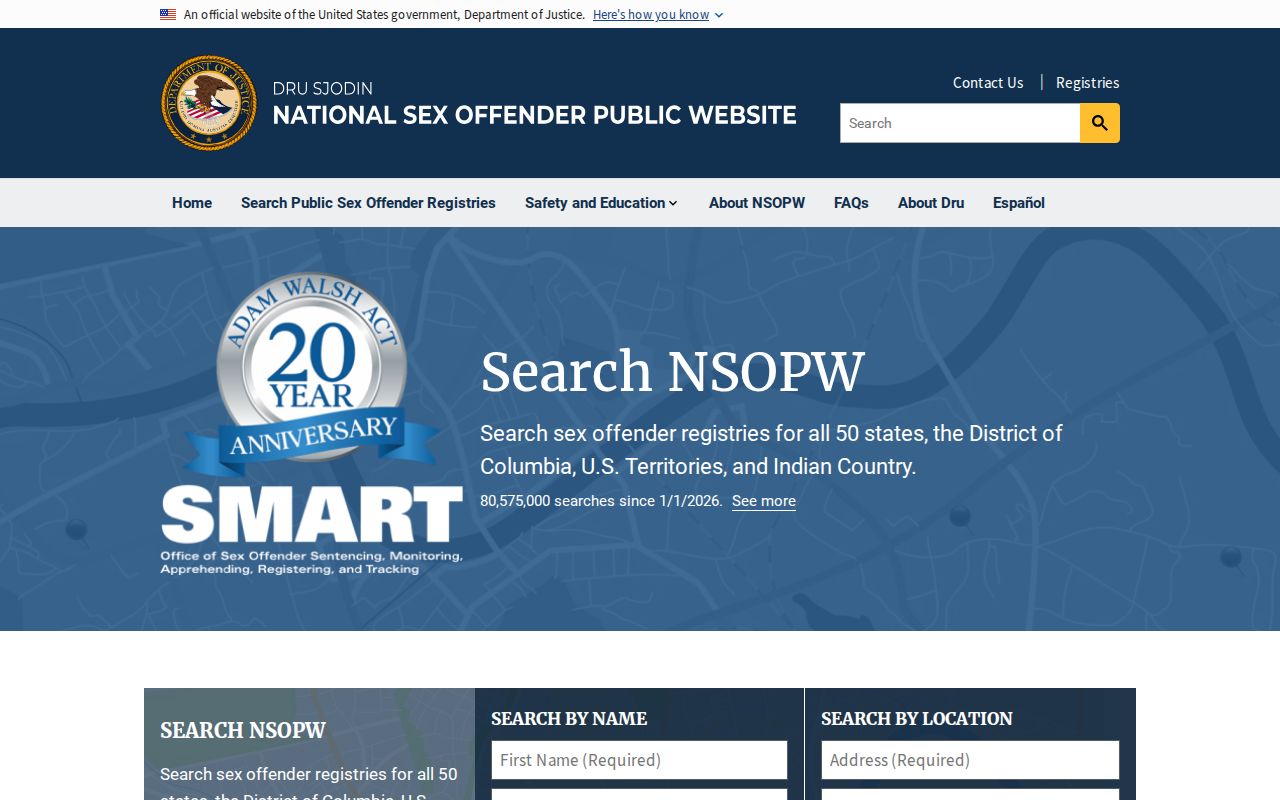
NSOPW gathers participating jurisdictions, while FDLE remains the best source for Florida profile detail and Indian River County filters. Report suspected noncompliance to IRCSO. Registry questions can also go to FDLE at 888-357-7332 or sexpred@fdle.state.fl.us.
If an alert and a saved flyer differ, open the current FDLE record and compare the status, address source, and received date. A change may reflect a move, confinement, supervision, deportation, or another registry update rather than a data error.
Using Registry Information Lawfully
Indian River County registry information supports personal, family, and community awareness. Use it to understand an official profile, plan a safety conversation, or choose whether to set an alert. Do not use a record to threaten, confront, shame, or punish a person or household. Send a suspected violation or inaccurate detail to the agency that can investigate and correct it.
Florida predator notification rules direct sheriffs or police chiefs to choose an appropriate method and notify licensed child-care facilities and K-12 schools within one mile in specified cases. Offender notification is authorized but is not identical in every case. A public reader should not imitate official notice with altered or false material.
Misuse can be a crime: Florida Statute §775.21(10)(d) makes specified misuse for payment, knowing false publication presented as registry data, or material alteration meant to misrepresent a record a first-degree misdemeanor. Never harass or engage in vigilantism.
Registry status and address are distinct. A profile can remain public after someone leaves Florida, with its status and address updated. Read the whole record, verify identity, and use official reporting channels rather than drawing conclusions from a thumbnail or pin.